pctechguide.com

  • Home
  • Guides
  • Tutorials
  • Articles
  • Reviews
  • Glossary
  • Contact

Scanner Operation

On the simplest level, a scanner is a device which converts light (which we see when we look at something) into 0s and 1s (a computer-readable format). In other word, scanners convert analogue data into digital data and can have a Document Data Capture.

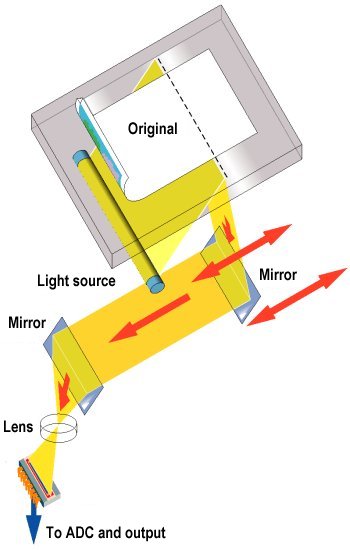
All scanners work on the same principle of reflectance or transmission. The image is placed before the carriage, consisting of a light source and sensor; in the case of a digital camera, the light source could be the sun or artificial lights. When desktop scanners were first introduced, many manufacturers used fluorescent bulbs as light sources. While good enough for many purposes, fluorescent bulbs have two distinct weaknesses: they rarely emit consistent white light for long, and while they’re on they emit heat which can distort the other optical components. For these reasons, most manufacturers have moved to cold-cathode bulbs. These differ from standard fluorescent bulbs in that they have no filament. They therefore operate at much lower temperatures and, as a consequence, are more reliable. Standard fluorescent bulbs are now found primarily on low-cost units and older models.

By late 2000, Xenon bulbs had emerged as an alternative light source. Xenon produces a very stable, full-spectrum light source that’s both long lasting and quick to initiate. However, xenon light sources do consume power at a higher rate than cold cathode tubes.

To direct light from the bulb to the sensors that read light values, CCD scanners use prisms, lenses, and other optical components. Like eyeglasses and magnifying glasses, these items can vary quite a bit in quality. A high-quality scanner will use high-quality glass optics that are colour-corrected and coated for minimum diffusion. Lower-end models will typically skimp in this area, using plastic components to reduce costs.
Flatbed

The amount of light reflected by or transmitted through the image and picked up by the sensor, is then converted to a voltage proportional to the light intensity – the brighter the part of the image, the more light is reflected or transmitted, resulting in a higher voltage. This analogue-to-digital conversion (ADC) is a sensitive process, and one that is susceptible to electrical interference and noise in the system. In order to protect against image degradation, the best scanners on the market today use an electrically isolated analogue-to-digital converter that processes data away from the main circuitry of the scanner. However, this introduces additional costs to the manufacturing process, so many low-end models include integrated analogue-to-digital converters that are built into the scanner’s primary circuit board.

The sensor component itself is implemented using one of three different types of technology:

  • PMT (photomultiplier tube), a technology inherited from the drum scanners of yesteryear
  • CCD (charge-coupled device), the type of sensor used in desktop scanners
  • CIS (contact image sensor), a newer technology which integrates scanning functions into fewer components, allowing scanners to be more compact in size.
  • Scanner Operation
  • PMT Scanners
  • CCD Scanners
  • CIS Scanners
  • Scan Resolution
  • Scanner Interpolation
  • Color Scanners
  • Bit-Depth Printers
  • Dynamic Range Scanners
  • Scan Modes
  • Scanner File Formats
  • TWAIN Drivers
  • Color Calibration
  • OCR Technology
  • Photo Retouching

Filed Under: Scanners

Latest Articles

NLX – New Low profile eXtended – form factor for motherboards

Intel's NLX design, introduced in 1997, is an improvement on the LPX design for low-profile systems, with an emphasis on ease of maintenance. The NLX format is smaller, typically 8.8in wide by 13in long, so well suited for low-profile desktop cases. All expansion slots, power cables and … [Read More...]

Color Calibration

One of the frustrations of using a desktop scanner is that a scanned image can look different on screen than it does when printed, and both can vary quite a bit from the original. The solution to this problem is a colour calibration (or colour … [Read More...]

Developing a Business Continuity Plan – 3 Things to Consider

If you run a business then you may already know the importance of backing up data, securing your network and fending off viruses and hackers. But, have you thought about what to do if the something physically happens to your infrastructure? Do you know what you would do if you had a fire, storm … [Read More...]

Comments

  1. Pergolesi says

    May 8, 2012 at 3:47 pm

    What is the date of this article?

  2. iknf says

    September 8, 2013 at 5:39 pm

    not bad

Importance of Inbound Marketing in the Digital Age

A couple of months ago, Zacks reported that Hubspot was starting to make some major changes to its inbound marketing strategy. They talk a lot about … [Read More...]

Damage Control Strategies for Resolving Online PR Crises

Last July, Astrologer faced a major crisis after its CEO went viral at a ColdPlay concert when having an affair. This was just one of the many times a … [Read More...]

AI is Not Killing Computer Jobs Like Doomers Projected

There is no denying the reality that AI technology has played a massive role in disrupting our lives. A growing number of people claim that AI … [Read More...]

Everything You Need to Know About Sourcing Circuit Boards From U.S. Suppliers

In This Article This article includes: Why Source PCBs From the United States?How to Get a Quote From a U.S.-Based PCB ManufacturerThe Top U.S. … [Read More...]

Top Taplio Alternatives in 2025 : Why MagicPost Leads for LinkedIn Posting ?

LinkedIn has become a strong platform for professionals, creators, and businesses to establish authority, grow networks, and elicit engagement. Simple … [Read More...]

Shocking Cybercrime Statistics for 2025

People all over the world are becoming more concerned about cybercrime than ever. We have recently collected some statistics on this topic and … [Read More...]

Guides

  • Computer Communications
  • Mobile Computing
  • PC Components
  • PC Data Storage
  • PC Input-Output
  • PC Multimedia
  • Processors (CPUs)

Recent Posts

Mobile AMD Athlon 4 technology guide

Emulating Intel's practice of introducing new technology in lower volume market sectors first, AMD's first deployment of … [Read More...]

LP to CD Connections

You can record from any analogue audio device that provides line-out terminals. Some analogue audio devices can be connected directly to your … [Read More...]

Bit-Depth Printers

When a scanner converts something into digital form, it looks at the image pixel by pixel and records what it sees. That part … [Read More...]

[footer_backtotop]

Copyright © 2026 About | Privacy | Contact Information | Wrtie For Us | Disclaimer | Copyright License | Authors