pctechguide.com

  • Home
  • Guides
  • Tutorials
  • Articles
  • Reviews
  • Glossary
  • Contact

Inkjet Thermal Technology

Most inkjets use thermal technology, whereby heat is used to fire ink onto the paper. There are three main stages with this method. The squirt is initiated by heating the ink to create a bubble until the pressure forces it to burst and hit the paper. The bubble then collapses as the element cools, and the resulting vacuum draws ink from the reservoir to replace the ink that was ejected. This is the method favoured by Canon and Hewlett-Packard.
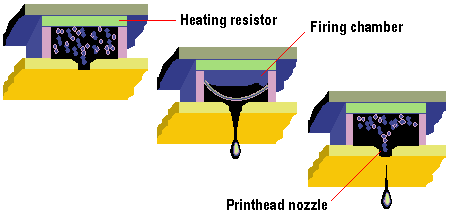
Thermal

Thermal technology imposes certain limitations on the printing process in that whatever type of ink is used, it must be resistant to heat because the firing process is heat-based. The use of heat in thermal printers creates a need for a cooling process as well, which levies a small time overhead on the printing process.

Tiny heating elements are used to eject ink droplets from the print-head’s nozzles. Today’s thermal inkjets have print heads containing between 300 and 600 nozzles in total, each about the diameter of a human hair (approx. 70 microns). These deliver drop volumes of around 8 – 10 picolitres (a picolitre is a million millionth of a litre), and dot sizes of between 50 and 60 microns in diameter. By comparison, the smallest dot size visible to the naked eye is around 30 microns. Dye-based cyan, magenta and yellow inks are normally delivered via a combined CMY print-head. Several small colour ink drops – typically between four and eight – can be combined to deliver a variable dot size, a bigger palette of non-halftoned colours and smoother halftones. Black ink, which is generally based on bigger pigment molecules, is delivered from a separate print-head in larger drop volumes of around 35pl.

Thermal

Nozzle density, corresponding to the printer’s native resolution, varies between 300 and 600dpi, with enhanced resolutions of 1200dpi increasingly available. Print speed is chiefly a function of the frequency with which the nozzles can be made to fire ink drops and the width of the swath printed by the print-head. Typically this is around 12MHz and half an inch respectively, giving print speeds of between 4 to 8ppm (pages per minute) for monochrome text and 2 to 4ppm for colour text and graphics.

  • Inkjet Operation
  • Inkjet Thermal Technology
  • Piezoelectric Printer Technology
  • Inkjet Color Perception
  • Creating Color
  • Inkjet Color Management
  • Inkjet Print Quality
  • Photo Printers
  • Inkjet Paper and Ink

Filed Under: Inkjet Printers

Latest Articles

AMD Athlon

The launch of the Athlon processor, in the summer of 1999, represented a major coup for AMD. It allowed them to boast not only of having produced the first seventh-generation processor - there are enough radical architectural differences … [Read More...]

Getting Started with Photoshop

Photoshop's dominance of the photo editing market is mainly due to the quality and efficiency of its tools. One of the benefits is that is relies on layers. Layers are the basic elements of any Photoshop project. If you do not understand how to use layers in Photoshop, anything you wish to … [Read More...]

Earning Effortlessly With Passive Income Apps: Reality or Scam?

The internet is full of everything – both good and bad. Therefore, it’s hardly surprising that people are cautious and take every promising idea with a grain of salt at first. Passive income applications are often viewed as especially suspicious since a lot of people believe earning more with little … [Read More...]

Everything You Need to Know About Sourcing Circuit Boards From U.S. Suppliers

In This Article This article includes: Why Source PCBs From the United States?How to Get a Quote From a U.S.-Based PCB ManufacturerThe Top U.S. … [Read More...]

Top Taplio Alternatives in 2025 : Why MagicPost Leads for LinkedIn Posting ?

LinkedIn has become a strong platform for professionals, creators, and businesses to establish authority, grow networks, and elicit engagement. Simple … [Read More...]

Shocking Cybercrime Statistics for 2025

People all over the world are becoming more concerned about cybercrime than ever. We have recently collected some statistics on this topic and … [Read More...]

Gaming Laptop Security Guide: Protecting Your High-End Hardware Investment in 2025

Since Jacob took over PC Tech Guide, we’ve looked at how tech intersects with personal well-being and digital safety. Gaming laptops are now … [Read More...]

20 Cool Creative Commons Photographs About the Future of AI

AI technology is starting to have a huge impact on our lives. The market value for AI is estimated to have been worth $279.22 billion in 2024 and it … [Read More...]

13 Impressive Stats on the Future of AI

AI technology is starting to become much more important in our everyday lives. Many businesses are using it as well. While he has created a lot of … [Read More...]

Guides

  • Computer Communications
  • Mobile Computing
  • PC Components
  • PC Data Storage
  • PC Input-Output
  • PC Multimedia
  • Processors (CPUs)

Recent Posts

OpenGL technology

Initiated in 1992 by Silicon Graphics as a general CAD and 3D API for Unix-based X-terminals, OpenGL evolved out of SGI's … [Read More...]

Ransomware Operators Find Data Theft Profitable

How valuable is your data? That’s not a question that organizations or individuals have to ask themselves all that often. You might know the market … [Read More...]

Motherboard Audio

Finally, some motherboards provide a pin header that allows connection to a front-mounted audio connector, designed to support stereo audio output … [Read More...]

[footer_backtotop]

Copyright © 2026 About | Privacy | Contact Information | Wrtie For Us | Disclaimer | Copyright License | Authors