In the UK, BT (British Telecom) commenced pilot trials of its ADSL technology – in north and west London – in late 1998. Early the following year, the company announced that it planned to spend £250m upgrading 400 local exchanges – out of the UK’s total of around 5,500 – to handle ADSL services by the end of March 2000. This first phase targeted the principal urban areas and was to be followed by an investment of a further £500m with the aim of providing access to ADSL technology to around 65% of the UK population during the subsequent 2/3 years. The remainder, mainly people living in remote areas, will not be able to benefit from the technology since it does not work more than five kilometres from a local exchange.
The fact that the two types of modem used in the pilot were based on different communications standards was the source of considerable controversy during the trials. The Alcatel system used Discrete-Multi-Tone (DMT) while the Fujitsu modem used Carrierless Amplitude (CAP). The former offered better performance at greater distances from the local exchange and was less disruptive of other analogue telephone services in close proximity. However, compared with the Fujitsu CAP equipment, it had much higher latency. Whilst this was of little consequence to subscribers who just wanted fast download speeds, it was a significant problem to users who wished to participate in multiplayer games.
In mid-1999 the European Union (EU) introduced a legal framework to force incumbent European telcos to allow other telecomms companies to lease its local access lines – the copper wire that runs from the local telephone exchange to customers’ homes – a process known as local loop unbundling (ULL). The original plan was for this to be accomplished by January 2001. Shortly after the introduction of the EU regulations, the UK government regulator for telecommunications (OFTEL) issued proposals for the opening up of BT’s local telephone lines to other networks in a bid to accelerate the availability of high-speed Internet access in the UK. Slated to come into force in July 2001, these were intended to open the way for other telecomms operators to be able to use their own DSL technology to provide broadband services to customers, including services like high-speed always-on Internet access and video-on-demand.
It was mid-2000 when BT’s ADSL services came to market. These comprised both retail products – aimed at consumers – and wholesale products – which enabled rival ISPs to offer similar ADSL connectivity to end users. These used DMT-based modems, and were typically available in download speeds of between 512 Kbit/s and 2 Mbit/s, with upload speed a constant 256 Kbit/s. Home user services used a USB connection to the host PC and were generally based on a 50:1 contention ratio, the more expensive business packages used an Ethernet connection and a 20:1 contention ratio. The service was only available to subscribers who were located within 3.5km from their local ADSL-enabled exchange.
The rollout of both ADSL services and the unbundling of the local loop were beset by problems – technical and administrative. In the case of the former, BT admitted that it had underestimated the capacity that would be required at ADSL-enabled exchanges as well as the number of engineers required to handle both the wholesale and retail implementation operations. In the case of the latter, there was also some question as to BT’s commitment to ULL, with many independent operators accusing the telco of being obstructive – not least for its claims that only 190 of the first 600 exchanges opened on the rolling timetable had sufficient space for co-location, and that the rest would require building separate buildings and connections. By late 2000, following a period of pressure from industry bodies and parliamentary committees, OFTEL had issued a groundbreaking directive to BT proposing that rival operators be able to get independent verification that there is not enough space in local exchanges for their equipment, that they be allowed to freely transfer space allocations in BT local exchanges and that there should be an independent body to resolve the inevitable disputes. BT would be liable to fines if they were found to be delinquent.
As 2000 drew to a close, BT claimed to be installing ADSL at around a rate of 5,000 end users a month – with plans to increase the rate to 15,000 by March 2001. However, with some reports forecasting that DSL subscribers would grow from 4.5 million in 2000 to 100 million by 2005, not much more than 2% of UK homes had a broadband connection by this time. This compared with 6% for homes in the USA and France and 3.3% in Germany. In parts of Asia the take-up of ADSL was better still, with Hong Kong having 7.6% of homes ready for broadband, Singapore 4% and Taiwan nearly 2%. In South Korea more than one in three online households has a broadband connection. On the ULL front the telco had committed to having 600 out of the UK’s 6000 telephone exchanges ready for other operators by July 2001, with another 200 being unbundled every month thereafter.
The summer of 2001 also saw the introduction of Rate Adaptive Digital Subscriber Line (RADSL), whose more tolerant distance from exchange limits gave many would-be subscribers who’d previously been disqualified on the grounds of poor line quality a second chance at obtaining broadband Internet access at their premises.
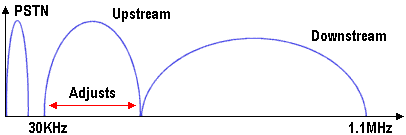
RADSL is a distance dependant technology. Previously, subscribers needed to be located within 3.5km from their local exchange in order to be able to receive ADSL. With rate adaption, reach is extended to about 5.5km and noise tolerances increased, from 41dB to 55db. The downside is that the maximum speed available is limited to 512 Kbit/s. Subscribers living between 3.5km and 5.5km from the exchange will still receive the same level of service downstream. However, the upstream bandwidth is dynamically adjusted to the highest speed possible by measuring the performance characteristics of the local loop. In practice this means it will typically be varied to between 64 Kbit/s and 256 Kbit/s, in 32 Kbit/s increments, as line quality or noise dictates. In general subscribers are unlikely to notice this. However, those playing online games or depending on uplink rates for remote access may observe the effect of the link slowing on occasion.
In the spring of 2002 BT responded to relentless criticism that its pricing policy was an impediment to the widespread adoption of broadband in the UK by dramatically its wholesale price for ADSL, enabling ISPs to purchase and resell broadband Internet access at substantially lower prices. That summer of 2002 – by which time 270,000 customers had been connected to ADSL – the company launched another initiative in pursuit of its target of one million broadband connections by summer 2003.
Its Broadband Registration Scheme required that customers wishing to sign up for ADSL broadband services to register their interest through a service provider who would in turn feed numbers into a central BT database so as to pull together total demand for each exchange. Following a survey to determine the number of users needed for an ADSL upgrade to be economically viable, trigger levels would be published for the exchange. Customers would be able to track the progress of the scheme online, both by checking to see if a trigger level has been set for their exchange and by monitoring its current level of registered demand. At the time the scheme was launched trigger levels ranging from 200 to 500 user registrations were published for the first 338 exchanges to be surveyed.
The effectiveness of the demand-led approach was illustrated in the autumn of 2002 when, ten weeks after the registration scheme had been launched, the first of the initial batch of exchanges reached its trigger level. By then some 1119 telephone exchanges had been upgraded for ADSL, meaning that 66% of UK homes and 68% of UK businesses were connected to an ADSL-enabled exchange.
- ISDN
- xDSL Digital Subscriber Line technologies – ADSL, HDSL, VDSL
- An Overview of ADSL – What It Is and How It Works
- Glite
- ADSL2
- ADSL2+ | ADSL2Plus | ITU G.992.5
- xDSL Variants
- ADSL Implimentation
- Wires-Only ADSL – Asymmetrical Digital Subscriber Line
- Cable Modems – for cable Internet connections
- A Description and Explanation of Satellite Broadband and How It Works