In 2002 the prospect of truly affordable film-quality digital cameras was given a massive boost when – after five years of research and development – Foveon Corporation unveiled a digital camera imaging sensor which the company claimed was capable of obviating 35mm film.
In conventional digital cameras systems colour filters are applied to a single layer of photo-detectors in a tilted mosaic pattern. The filters let only one wavelength of light – red, green or blue – pass through to any given pixel, allowing it record only one colour. As a result, typical mosaic sensors capture 50% of the green and only 25% of each of the blue and red light. The approach has inherent drawbacks, no matter how many pixels a mosaic-based image sensor might contain. Since they only capture one third of the colour, mosaic-based image sensors must rely on complex processing to interpolate the two-thirds they miss. Not only does this slow down the speed of image rendering, interpolation also leads to colour artefacts and a loss of image detail. Some cameras even intentionally blur pictures to reduce colourartefacts.

Foveon’s new CMOS image sensor uses the company’s revolutionary X3 technology to capture up to three times more information per pixel than modern-day digital cameras at similar megapixel resolutions. The X3 image sensors accomplish this by using three layers of photodetectors embedded in silicon. The layers are positioned to take advantage of the fact that silicon absorbs different colours of light at different depths, so one layer records red, another layer records green and the remaining layer records blue. This means that for every pixel on a Foveon X3 image sensor, there’s actually a stack of three photodetectors. The result is a sensor capable of capturing red, green, and blue in each pixel location – in essence, the first full-colour digital camera image sensor.

Foveon’s X3 technology not only leads to better pictures, but better cameras too. In fact, it opens the door to an entirely new breed of camera, one that can switch seamlessly between still photography and digital video, without sacrificing the quality of either. Because Foveon X3 image sensors capture full colour at every pixel location, those pixels can be grouped together to create larger, full-colour super pixels. This capability, called Variable Pixel Sizing (VPS), marks another first in digital photography.
With VPS, the signals from groups of pixels can be combined so the camera reads them as one. For example, a 2300×1500 image sensor contains more than 3.4 million pixels. But if VPS is used to group those pixels into 4×4 blocks, the image sensor would appear to have 575×375 pixels, each of them 16 times larger than the originals. The size and configuration of a pixel group is variable – 2×2, 4×4, 3×5, etc. – and is controlled through sophisticated circuitry integrated into Foveon X3 image sensors.
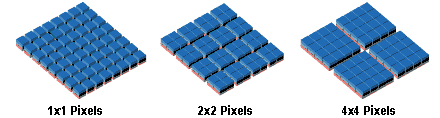
The grouping of smaller pixels into larger pixels increases the signal-to-noise ratio. This allows the camera to take full-colour pictures in low-light conditions with reduced noise. Using VPS to reduce the resolution also allows the sensor to run at higher frame rates, accelerating the rate at which pictures can be taken. These gains in speed and sensitivity offer other benefits such as an improved focusing system.
VPS also makes it possible to switch from high-quality still photography to outstanding digital video, enabling the development of the first cameras with true dual-mode functionality. Hitherto, cameras attempting to accommodate both still and video functions have had to sacrifice performance in one mode to do the other well. The unique design of Foveon X3 image sensors enables them to handle both functions without compromise.
- What is CCD in the Context of Digital Cameras?
- CMOS Digital Cameras
- What Controls The Picture Quality of a Digital Camera
- Features and Parts of a Digital Camera
- PIM Technology
- Digital Camera Batteries: Types and How They Work
- Memory Storage
- Storage of Photos and Videos on Digital Cameras
- Digital Camera Connectivity
- Digital Cameras vs. Film
- X3 Technology
- What is PictBridge and PTP?